
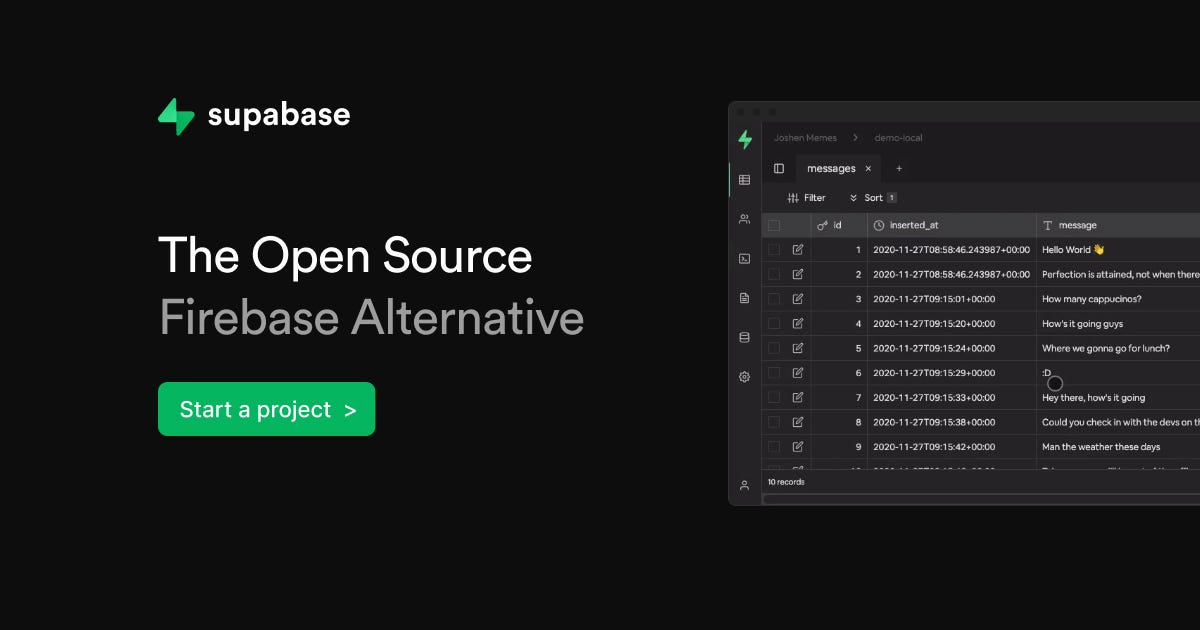
For years, Google's Firebase has been the go-to Backend-as-a-Service (BaaS) for developers needing to build apps quickly. It offers a suite of tools—Authentication, Firestore, Cloud Functions, and more—that simplify backend development. However, a powerful open-source alternative has emerged and is quickly winning developers over: Supabase.
Supabase markets itself as "the open source Firebase alternative," but I believe it's more than that. After using it for several projects, I've found its unique approach offers compelling advantages.
1. The Power of PostgreSQL
This is the single biggest differentiator. While Firebase's Firestore is a NoSQL document database, Supabase is built on top of PostgreSQL, one of the world's most trusted and powerful relational databases. This provides several key benefits:
- Structured Data and SQL: You can enforce data integrity with schemas and perform complex queries with the full power of SQL.
- Row Level Security (RLS): Supabase leverages PostgreSQL's built-in RLS to provide fine-grained, scalable security policies directly in the database.
- An Existing Ecosystem: You can use the vast ecosystem of PostgreSQL tools, libraries, and extensions that have been developed over decades.
"Supabase doesn't try to reinvent the database. It embraces PostgreSQL and enhances it with a modern, real-time API."
2. Open Source and No Vendor Lock-in
Firebase is a proprietary, closed-source product. If you ever need to migrate away, it can be a significant challenge. Supabase is completely open source. You can use their hosted platform for convenience or self-host the entire stack on your own infrastructure for complete control. This flexibility is a massive win for long-term project viability.
3. Auto-Generated APIs
When you create a table in your Supabase database, it automatically generates a RESTful API and a real-time API for you. There's no need to write boilerplate code for basic CRUD (Create, Read, Update, Delete) operations. The real-time functionality is particularly impressive, allowing you to subscribe to database changes with just a few lines of code.
// Listen to all new inserts in the 'messages' table
const subscription = supabase
  .from('messages')
  .on('INSERT', payload => {
    console.log('New message received!', payload.new);
  })
  .subscribe();
When is Firebase Still a Good Choice?
Firebase is not obsolete. Its deep integration with the Google Cloud ecosystem, its mature and battle-tested infrastructure, and features like Cloud Functions for serverless logic still make it a strong contender, especially for projects that benefit from a NoSQL data model and need to scale to massive, unpredictable traffic levels.
Conclusion
For me, Supabase hits the sweet spot. It combines the reliability and power of PostgreSQL with the developer experience of a modern BaaS. The control offered by its open-source nature, coupled with the familiar power of SQL, makes it my default choice for new projects. If you're starting a new application, I highly recommend giving Supabase a serious look.